
Food & Hospitality
Book Design Bibliography
Lopez, Bricia, and Javier Cabral.
Asada: The Art of Mexican‑Style Grilling. Abrams, 2023.
Bitsoie, Freddie, and James O. Fraioli.
New Native Kitchen: Celebrating Modern Recipes of the American Indian. Abrams, 2021.
Paredez, Petra. P
ie for Everyone: Recipes and Stories from Petee’s Pie, New York’s Best Pie Shop. Abrams, 2020.
Lopez, Bricia, and Javier Cabral.
Oaxaca: Home Cooking from the Heart of Mexico. Abrams, 2019.
Hornby, Jane.
Simple & Classic: 123 Step‑by‑Step Recipes. Phaidon, 2019.
Tamarkin, David.
Cook90: The 30-Day Plan for Faster, Healthier, Happier Meals. Little, Brown and Company, 2018.
Stewart, Martha.
A New Way to Bake: Classic Recipes Updated with Better‑for‑You Ingredients from the Modern Pantry. Clarkson Potter, 2017.
Stewart, Martha.
Martha Stewart’s Vegetables: Inspired Recipes and Tips for Choosing, Cooking, and Enjoying the Freshest Seasonal Flavors. Clarkson Potter, 2016.
Stewart, Martha.
Clean Slate: A Cookbook and Guide—Reset Your Health, Detox Your Body, and Feel Your Best. Clarkson Potter, 2014.
Hornby, Jane.
What to Bake and How to Bake It. Phaidon, 2014.
Hornby, Jane.
What to Cook and How to Cook It: Fresh and Easy. Phaidon, 2012.
Hornby, Jane.
What to Cook and How to Cook It. Phaidon, 2010.
Sheridan, Michael.
Room 606: The SAS House and the Work of Arne Jacobsen. Phaidon, 2003.
From the archive
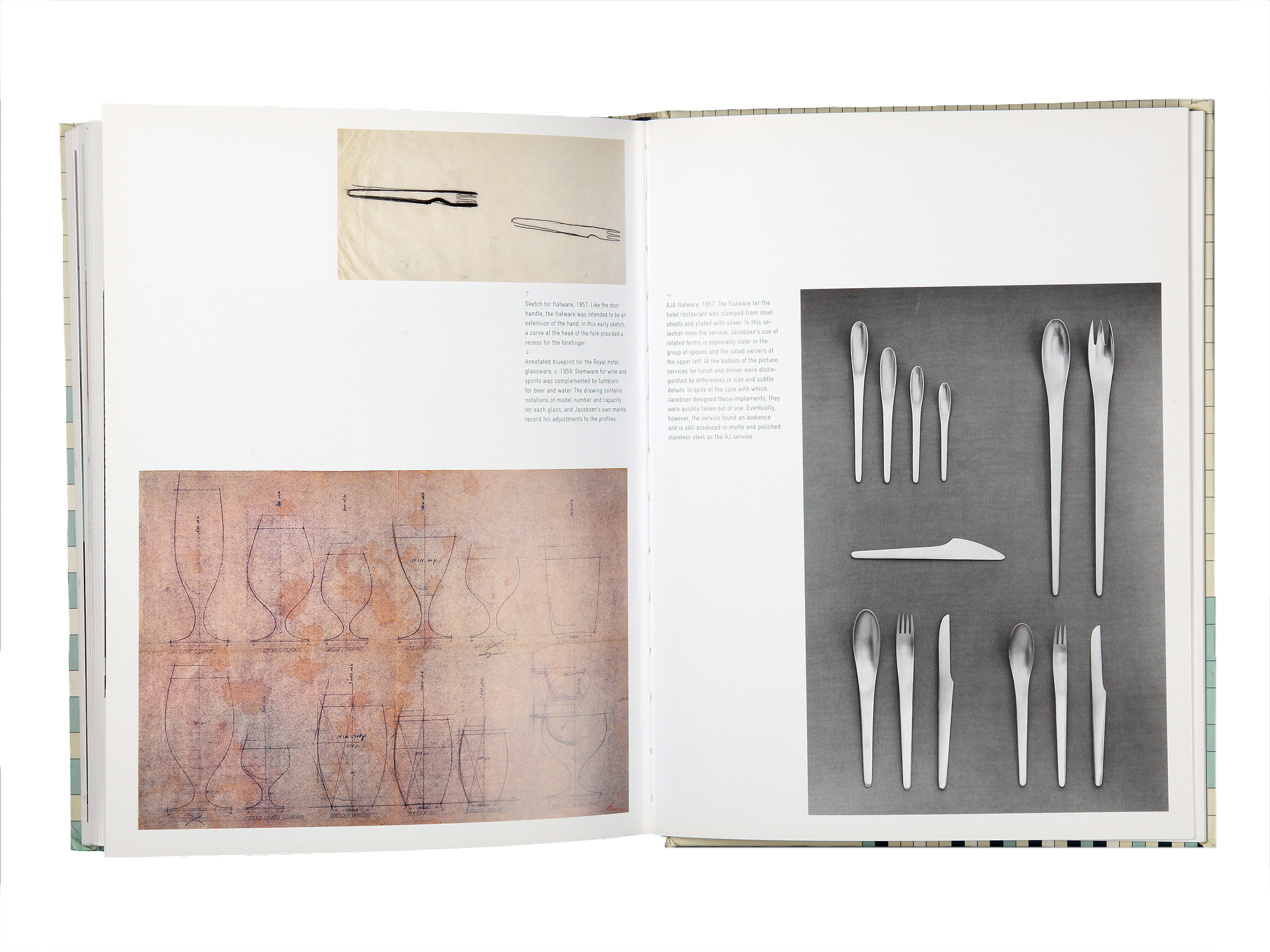
Arne Jacobsen’s Tableware for the Royal Hotel
from Room 606: The SAS House and the Work of Arne Jacobsen.Phaidon, 2003.
Every line in these documents speaks to an almost devotional care. Jacobsen’s 1957 flatware (top left sketch, right photograph) was not simply designed—it was considered as an extension of the human hand itself, with the fork’s curved head carefully shaped to cradle the forefinger. Each piece was stamped from steel sheets and silver-plated, a process demanding precision at every stage. The family resemblance among the spoons and salad servers reveals a designer thinking in harmonies, not objects. His annotated blueprint for the hotel’s glassware (bottom left, c. 1959) shows the same patient intelligence: stemware for wine and spirits thoughtfully paired with tumblers for beer and water, each vessel calibrated to its purpose. Even the distinction between lunch and dinner services—achieved through the most subtle shifts in proportion and detail—demonstrates craft elevated to an art form. Though initially removed from use, the flatware’s quiet excellence eventually found recognition. Today it endures as the AJ service, a testament to work done with unwavering attention.