
Who we are
Field Office is a land-led brand studio for independent hotels, estates, and heritage brands. We spend time on the ground to find what makes a place irreplaceable, then help you build it into your brand, your team, and your story.
Our work spans identity, editorial, brand strategy, and writing, from a single logo to a full brand system. For hospitality properties, we offer The Terroir Atelier™, our proprietary methodology for uncovering what makes a property impossible to replicate. For any other heritage brand, we offer Meaningful Disruption: the same questions, applied wherever specificity is the asset worth protecting.
We surface the stories no one’s telling yet, foster collaboration across disciplines, and back ideas that benefit the land, community, and the local economy. We don’t manufacture your story; we help you find it, name it, and protect it.
Jennifer Wagner
Founder,
Director of Place & Story
—
Jennifer Wagner
hello@wearefieldoffice.com
Jennifer leads Field Office’s storytelling and design practice, guiding projects that bring together culinary traditions, craftsmanship, and sustainability through thoughtful, research-driven design systems.
Before co-founding Field Office, Jennifer served as Creative Director of Martha Stewart Living. She was also founding Art Director of Martha Stewart Baby and Martha Stewart Kids, where she helped define a visual language for domestic culture.
Her approach—rooted in journalism and cultural research—extends naturally to Field Office’s development process, where understanding precedes design. Jennifer’s work honors the stories that shape place: from the farmers and chefs who sustain local foodways to the artisans preserving heritage techniques.
Her creative contributions have been recognized by the Type Directors Club, AIGA’s 50 Books/50 Covers, the Art Directors Club, and Magazine of the Year by the Society for Publication Designers. Her work continues to explore how design can honor tradition while advancing regenerative and sustainable futures. She splits time between Zürich and the Hudson Valley.
Nico Schweizer
Co-founder,
Director of Brand & Narrative
—
Nico Schweizer
office@wearefieldoffice.com
Nico leads Field Office’s brand strategy and creative direction, combining eight years of experience at The New Yorker with a background in type and product design. His work bridges editorial precision with the operational fluency needed to build brands that endure.
At The New Yorker, he helped extend a century-old cultural identity across new platforms, from product design to campaign strategy—developing an understanding of how institutional heritage evolves without losing authenticity. That philosophy now guides Field Office’s process: research first, design second. Every brand system grows from truth, not trend.
Originally trained in Switzerland, Nico has taught at The Cooper Union and ÉCAL, and his work has been recognized by the Art Directors Club, D&AD, and the Society for Publication Designers. When not developing brand narratives, he stewards an olive grove and vineyard in Italy, continuing his lifelong connection between design, land, and care.
From the archive
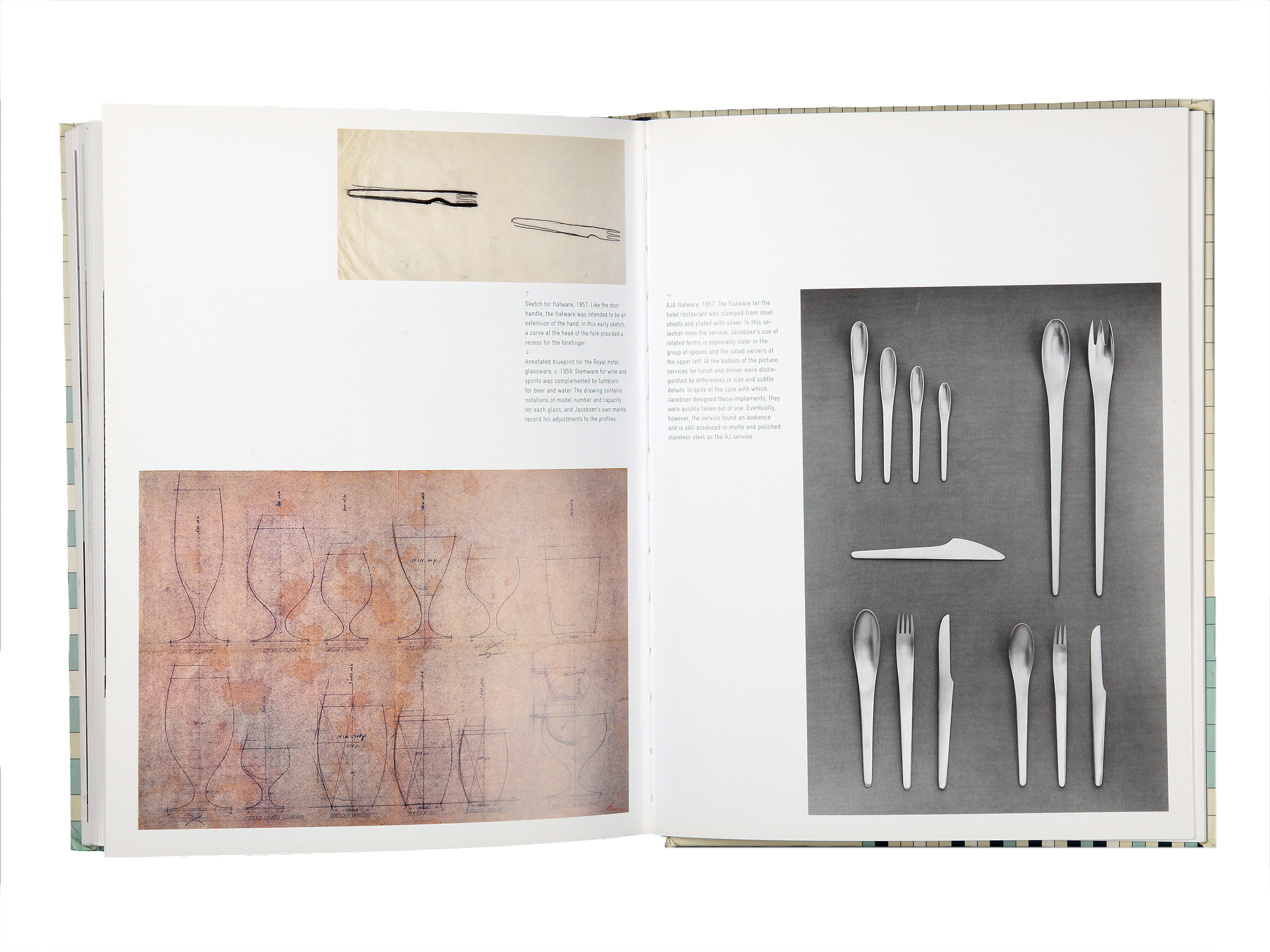
Arne Jacobsen’s Tableware for the Royal Hotel
from Room 606: The SAS House and the Work of Arne Jacobsen.Phaidon, 2003.
Every line in these documents speaks to an almost devotional care. Jacobsen’s 1957 flatware (top left sketch, right photograph) was not simply designed—it was considered as an extension of the human hand itself, with the fork’s curved head carefully shaped to cradle the forefinger. Each piece was stamped from steel sheets and silver-plated, a process demanding precision at every stage. The family resemblance among the spoons and salad servers reveals a designer thinking in harmonies, not objects. His annotated blueprint for the hotel’s glassware (bottom left, c. 1959) shows the same patient intelligence: stemware for wine and spirits thoughtfully paired with tumblers for beer and water, each vessel calibrated to its purpose. Even the distinction between lunch and dinner services—achieved through the most subtle shifts in proportion and detail—demonstrates craft elevated to an art form. Though initially removed from use, the flatware’s quiet excellence eventually found recognition. Today it endures as the AJ service, a testament to work done with unwavering attention.